
What I got wrong about nuclear

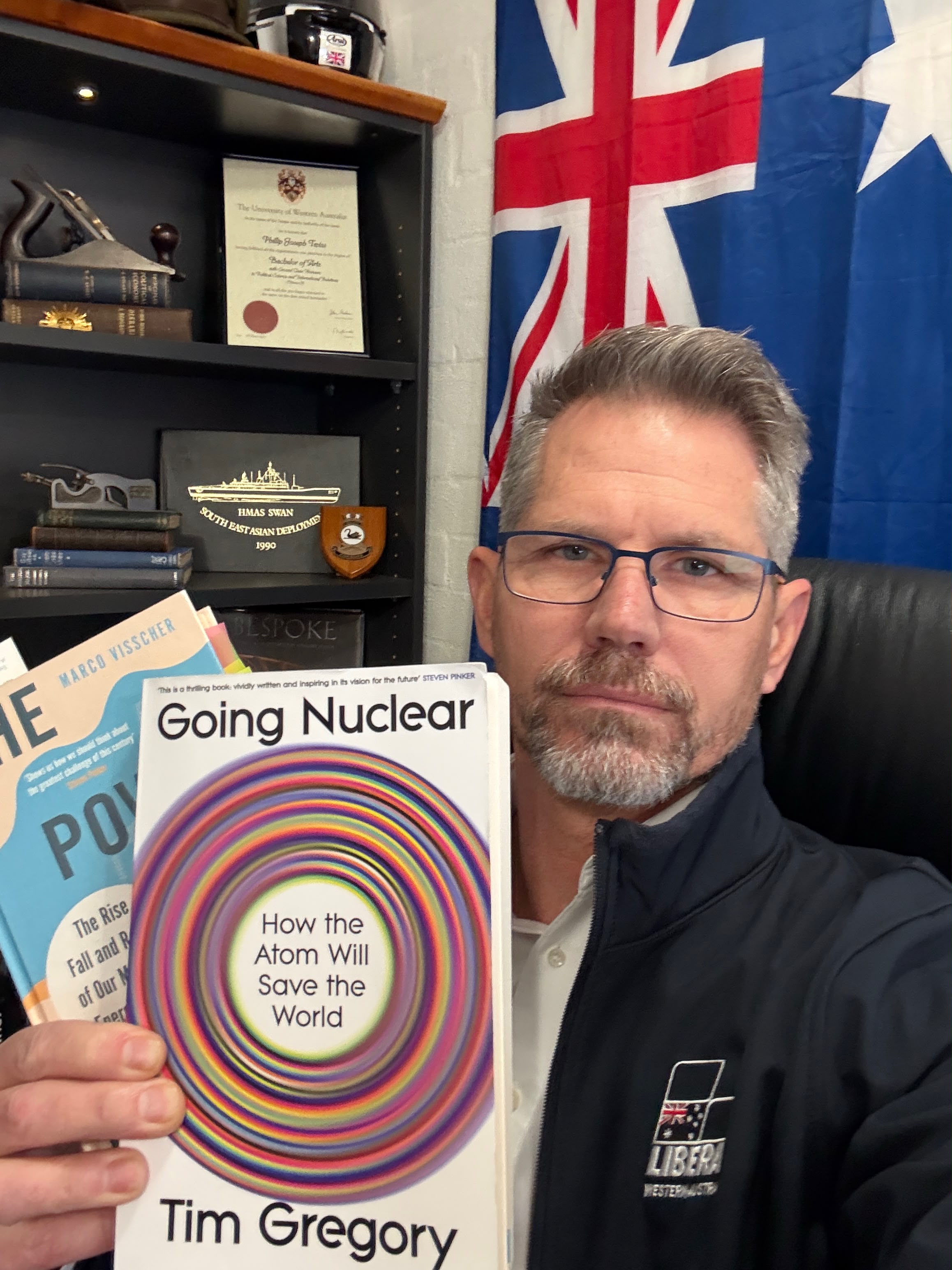
Recently I wrote to you about the uranium mining ban in Western Australia. This week I want to go a step further.
Over the past year I've done a lot of reading, a lot of thinking, and spent time with people who work in this field. And I've had to confess something: for most of my life I was largely ignorant of the true nature of nuclear energy.
The two books that did the most to change my mind are pictured below. I'd recommend both to anyone willing to look at the evidence with an open mind. Going Nuclear is by Tim Gregory, a working nuclear chemist. The Power of Nuclear is by Marco Visscher, a Dutch journalist and environmentalist who once wanted nothing to do with anything nuclear and changed his position entirely once he examined the facts.
Neither of these authors is a conservative culture warrior - both came to nuclear energy as environmentalists.
Here is what the evidence actually shows.
Most of what the public has been told about nuclear waste, safety and radiation is simply not true. Across seventy years, the handful of "disasters" people can name have been extraordinarily rare, and their real human impact vanishingly small. Long-term radiation exposure has been shown to have practically no effect on human health - we live with background radiation every day of our lives regardless.
Where to From Here?
Nuclear energy remains an incredibly safe and healthy form of power generation that has the potential to provide clean energy on a massive scale backed by an industry absolutely committed to ongoing improvement and safety as its highest priority.
The technology is proven, and what holds it back is not safety, but crushing over-regulation, much of it demanded by activists who will never support nuclear no matter how clean or safe it becomes.
For many of them, opposition isn't a position anymore. It's a religion.
Here is what's at stake: if Australia is going to prosper, we need enormous amounts of energy. Nuclear delivers exactly that: intense, reliable, emissions-free power that can slot into the distribution infrastructure we already have without the multi-generational dependence on short-lived technology, without the environmental destruction, and without the endless waste problems we're being sold as the "green" alternative.
The people who claim to speak for the environment have had it backwards for decades. I'd encourage you to read the books, weigh the evidence, and judge for yourself.
I'll continue advocating for this change and I won't stop until the evidence is given the hearing it deserves.

Into the Radioactive Weeds
Being who I am, I can’t help but talk about the things I’m reading - especially when I discover just how wrong the public information is that we are so often fed by an uncritical or complicit media. The real story of the nuclear accidents since energy was first sent to the grid may seem dramatic, and news reports, politicians, and activists love to play up apocalyptic scenarios that come to mind. In reality, things are much less spectacular.
The first commercial nuclear power station, Calder Hall in the United Kingdom, started producing power in 1956 and ran until 2003 without incident. 47 years of emissions-free energy from the earliest technology.
In 1957, the UK had its first significant incident when the nearby Windscale reactor caught fire, releasing radioactive iodine-131, polonium-210, and caesium-137. While widespread precautions were taken due to fears of milk potentially contaminated with iodine-131, there were no fatalities, and background radiation levels, at worst, affected a handful of people in numbers statistically indistinguishable from normal recorded cancer levels in the population. In fact, many people today are exposed to much higher radiation levels through air travel, medical treatments such as CT scans, or simply where they live.
In 1979, the Three Mile Island reactor experienced an INES Level 5 event (the same level as Windscale). There were zero casualties and zero confirmed radiation deaths. No causal link between the incident and cancer rates has since been found.
In 1986 the Chernobyl nuclear power station In Ukraine had melt down in on one of its cores, reactor 4, causing an explosion and creating an INES Level 7 event (the highest level). Two workers died instantly in the initial fire, and 28 other workers died as a result of direct exposure to the radioactive materials, largely due to the Soviet Union's poor safety practices, but also because of the incredible heroism of the first responders. Long term studies have been inconclusive as to the total number of cancers, which are likely to be only a few hundred. All tragic, but nothing like the tens of thousands across Europe often stated, and recently the subject of a dramatic HBO miniseries.
When tested, the contaminated areas of Ukraine, Belarus, and Russia showed elevated levels of radiation around 9 millisieverts, which is about the same level as a CT scan and only a few millisieverts above natural background levels in places like Cornwall. Furthermore, the often-feared birth defects never eventuated.
The much more recent Fukushima Daiichi incident in the wake of the 2011 Japanese tsunami was of a similar magnitude and also an INES Level 7 event in which three of the reactor cores ended up melting down due to a failure of the cooling systems. There were no direct casualties despite the meltdown and no casualties that can be attributed to the release of radioactive materials. Yet, much of the reporting across the world focused on the Fukashima incident, when around 19,500 died as a result of the Tsunami across Japan. Ironically, those who fled Japan and flew back to places like the US, Europe, and Australia were exposed to more radiation during the flight than if they had stayed where they were.
By contrast, in 1984 the Union Carbide factory in Bhopal, India, exploded, ultimately killing an estimated 16,000 and affecting somewhere in the order of half a million people. Deaths from air pollution from coal are estimated at anywhere from from hundreds of thousands to over a million annually. Hundreds of thousands suffer respiratory illnesses and die due to wood smoke in developing nations.
Latest
We are not Europe. Not yet
Posted by Hon Phil Twiss Mlc on October 21, 2026

On Sunday morning, I, like so many of you, woke to footage of France burning. What we were told...
The State has no money of its own
Posted by Hon Phil Twiss Mlc on October 07, 2026

On Tuesday 29 September, while many Western Australians were still reeling from the Dockers' heartbreaking Grand Final loss, the Cook...
We are in an Orwellian state
Posted by Hon Phil Twiss Mlc on October 01, 2026

"Once the state can force you to believe something that is not true, or to accept something that is...
If Frisby Court wasn't squalid, I don't know what is
Posted by Hon Phil Twiss Mlc on September 23, 2026

Last Sunday, over my morning coffee, I thought I would take a moment to check out any breaking news on...